

Overview
Teams that keep security policies, runbooks, and product documentation in a GitHub repository can make that content answerable in Wolfia without copying it anywhere. You choose the repositories, branches, and files to include, and Wolfia keeps its knowledge base in step with the repository as files change.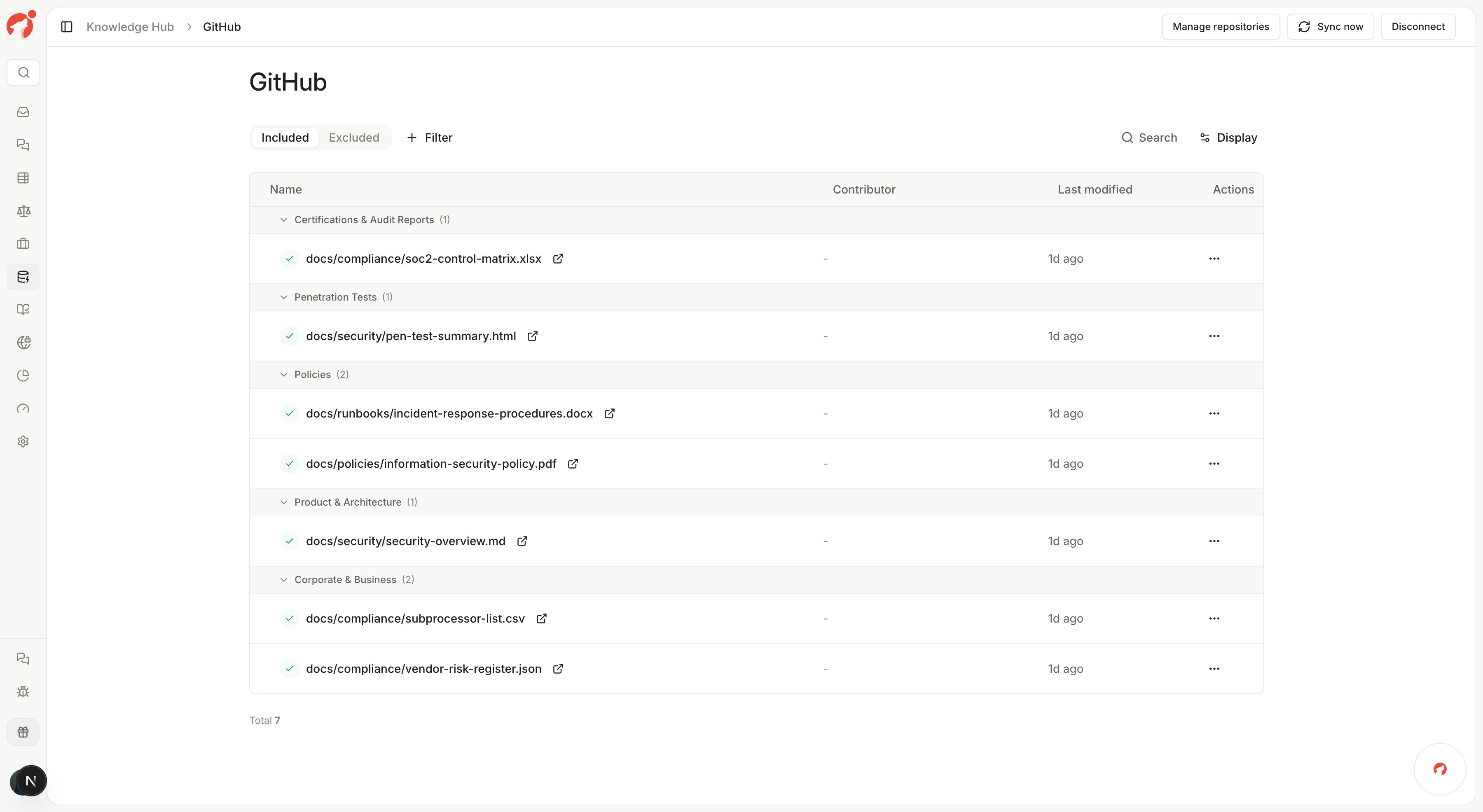
What we sync
- Documentation files - Markdown (
.md,.mdx), plain text, HTML, and JSON - Office documents - Word (
.docx,.doc), Excel (.xlsx,.xlsm,.xls), PowerPoint (.pptx), and CSV - PDFs - Policy documents, reports, and attestations
- Images - PNG, JPG, and WebP diagrams such as architecture overviews
- Email files -
.emlmessages saved into the repository
Prerequisites
- A GitHub organization or user account with the repositories you want to sync
- Permission to install a GitHub App on that organization or account
- Admin role in Wolfia to connect the integration
Setup instructions
1
Connect GitHub
Navigate to Knowledge Hub in the left sidebar, find the GitHub integration, and click Connect. You will be redirected to GitHub to install the Wolfia app.
2
Choose repositories on GitHub
During installation, grant access to all repositories or only the specific repositories you want Wolfia to read. You can change this later from your GitHub settings.
3
Select repositories and branches in Wolfia
Back in Wolfia, click Manage repositories, pick the repositories to sync, and choose the branch to read from for each one.
4
Pick the files to include
Browse the repository file tree and select the folders and files to bring into your knowledge base. Only supported file types are selectable.
5
Sync
Click Sync now to run the first sync. Files appear in the Knowledge Hub with their repository paths, grouped into folders such as Policies and Certifications & Audit Reports as they are classified.
How syncing works
- Automatic refresh - Synced repositories refresh once a day, so answers reflect your latest committed documentation.
- Only changes are re-processed - Sync now and the daily refresh compare each file against the version already synced. Unchanged files are skipped, so syncs stay fast even in large repositories.
- Deletions are honored - When a synced file is removed from the repository, its content is removed from your knowledge base on the next sync.
- Facts are extracted automatically - After a file syncs, Wolfia extracts the facts it contains so they can be used in questionnaire answers, chat, and RFP responses.
Good practices
- Sync from your default branch so the knowledge base always reflects reviewed, merged content.
- Keep customer-facing documentation in dedicated folders (for example
docs/policies/,docs/security/) and select those folders rather than the whole repository. - Use descriptive file names. The file path is shown in the Knowledge Hub and helps your team find sources quickly.
FAQ
Which file types are supported?
Which file types are supported?
Markdown, MDX, plain text, HTML, JSON, PDF, Word, Excel, PowerPoint, CSV, PNG, JPG, WebP, and EML files are supported. Unsupported file types do not appear in the file picker.
Does Wolfia read my source code?
Does Wolfia read my source code?
Wolfia only syncs the files you explicitly select. If you select only documentation folders, source code is never read into the knowledge base.
What happens when I click Sync now?
What happens when I click Sync now?
Wolfia checks the selected files against the repository and re-processes only the files that changed since the last sync. Files that are unchanged are skipped.
How do I disconnect?
How do I disconnect?
Click Disconnect on the GitHub page in the Knowledge Hub. You can also uninstall the Wolfia app from your GitHub organization settings.
Related pages
GitLab integration
Sync documentation from GitLab projects the same way.
Knowledge base
How Wolfia organizes and uses your synced knowledge.
Adding knowledge
Other ways to bring content into Wolfia.
Confluence integration
Sync pages and attachments from Confluence Cloud.